Stray Cats 101: A Rockabilly Primer for Young Listeners

Picture a club owner in late-1970s New York who won't book the same band two nights running. The band's answer? Change the name. The Tomcats one night, the Teds another, Bryan and the Tom Cats after that, with "Cats" kept in every version so the regulars knew who was really on stage. By 1983 there was only one name left: Stray Cats.
If a young listener in your life has just discovered "Rock This Town" or "Stray Cat Strut", this is a quick primer on the band behind them: who they are, where to start listening, and which Stray Cats pieces make a good first shirt or hoodie.
Who are Stray Cats?
Stray Cats are an American rockabilly band, formed in 1979 in Massapequa, on Long Island, New York. The classic trio is easy to remember because there are only three of them:
- Brian Setzer on lead vocals and guitar
- Lee Rocker on double bass and vocals
- Slim Jim Phantom on drums and vocals
The sound is 1950s rock and roll played with early-1980s energy: slapped upright bass, a hollow-body guitar, a stripped-down drum kit and a lot of swagger. Wikipedia files them under rockabilly and new wave, which sums up the trick they pulled off. They took a sound from their parents' record collections and made it feel brand new.
The look matters too. Quiffs, leather jackets, western jackets, polka dots, leopard spots and tattoos. It is one of the most recognisable styles any band has worn, and it is a big part of why their artwork still looks so good on a shirt.
Where should a new listener start?
The early run is the best way in. The self-titled Stray Cats came out in the UK in 1981 on Arista, produced with Dave Edmunds, followed the same year by Gonna Ball. Then came Built for Speed in 1982, the US release that went Platinum in the United States and Canada and put the trio on the map at home.
A starter playlist practically writes itself:
- "Rock This Town": the one most people already half-know.
- "Stray Cat Strut" (1981): slinky, cool and impossible not to tap along to.
- "Runaway Boys": the early single that shows how hard they could push.
- "I Won't Stand in Your Way": proof they could slow it down too.
After that, Rant N' Rave with the Stray Cats (1983) rounds out the first era. For a live taste, Rumble in Brixton captures the band after their 2004 tour. And for something recent, 40 arrived in 2019 to mark four decades of the band.
Why do Stray Cats keep coming back?
Few bands have had as many second acts. The trio ended in 1984 after a show at the Louisiana World Exposition, then returned in 1986. They toured with Stevie Ray Vaughan in 1989, played a European tour in 2004, went out across the US with ZZ Top and the Pretenders in 2007, and staged a farewell tour in 2008 and 2009.
Farewell turned out not to be final. Stray Cats played shows again in 2018, released 40 in 2019 with a 40th-anniversary tour, and toured the US again in the summer of 2024. Along the way, in October 2006, the band was inducted into the Long Island Music Hall of Fame, a fitting honour for three friends from Massapequa.
The Stray Cats store tells this story well in its post Nine lives: our breaks and comebacks, the band's own walk through each split and return. It is a good read for anyone who wants the whole timeline in one place.
Which Stray Cats pieces suit a young listener?
The band's artwork is bold, graphic and full of character, which makes it a natural fit for kids' and youth sizes. A few that stand out:
- The Setzer Rocker Phantom crest. Cream, red and black, with the cat head, flames and all three names. It is the easiest way to show you know the lineup.
- The cat heads. The Big Blue Quiff and Script Cat Head designs give the band's cat a blue-streaked black quiff and a cheeky red tongue. Playful enough for a young kid, cool enough for a teenager.
- The Leopards. Two snarling spotted leopards under chunky yellow letters with a red outline: pure rockabilly, with that leopard-spotted streak from the band's photos.
- The tour pieces. The 40th Anniversary Tour 2019 design sets the name on teal and orange sign panels beside a framed list of US cities, and the Euro Tour 08 design carries its cities and dates on the back.
- The Pink Block Logo. The name stacked in hot-pink letters with a thick black shadow, for the kid who likes it loud.
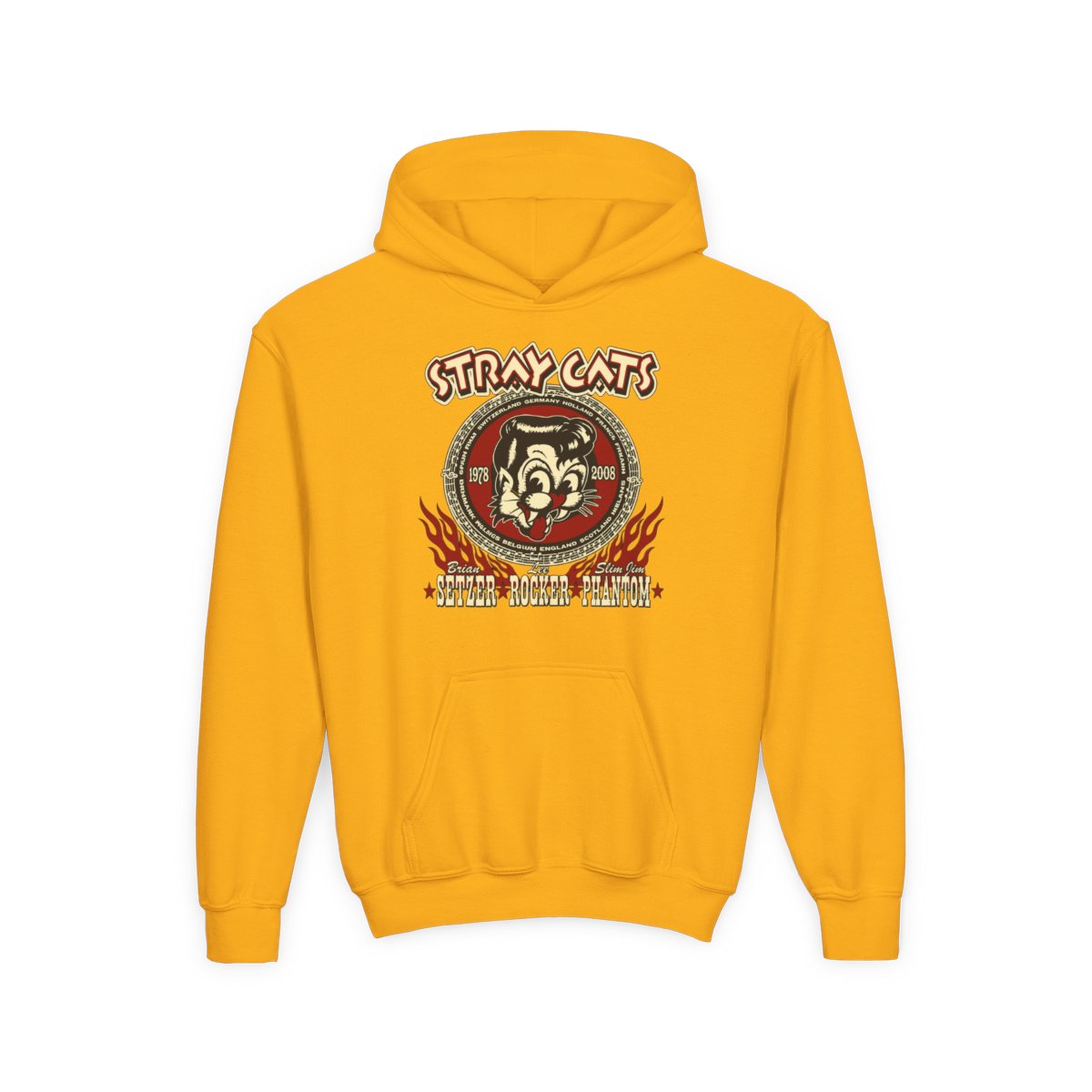
For colder months, the Setzer Rocker Phantom youth hoodie is a strong pick: the crest reads clearly from across the room, and the three names give a curious kid an easy way into the band's story.
How do you pair it with a young STAY's wardrobe?
If the young person you are shopping for already wears our Stray Kids kids' tees, rockabilly art sits surprisingly well beside them. The Pink Block Logo's hot pink echoes the pink in our Pink Arrow and Spiky Star designs, while the Leopards' red and yellow sits nicely next to the Flame Script tee. A black cat-head tee under an open flannel or a denim jacket nods to the band's own leather-and-western look without any effort.
The simple rule: let one bold graphic lead and keep the rest plain. Dark jeans, a plain jacket, and the artwork does the talking.
The takeaway
Stray Cats are a great first rockabilly band for a young listener: three names to learn, a handful of songs everyone knows, and more than four decades of comebacks to dig into. Start with Built for Speed, play "Stray Cat Strut" loud, and let the crest, the cat heads or the leopards be the piece that makes the music stick.